7 September 2026
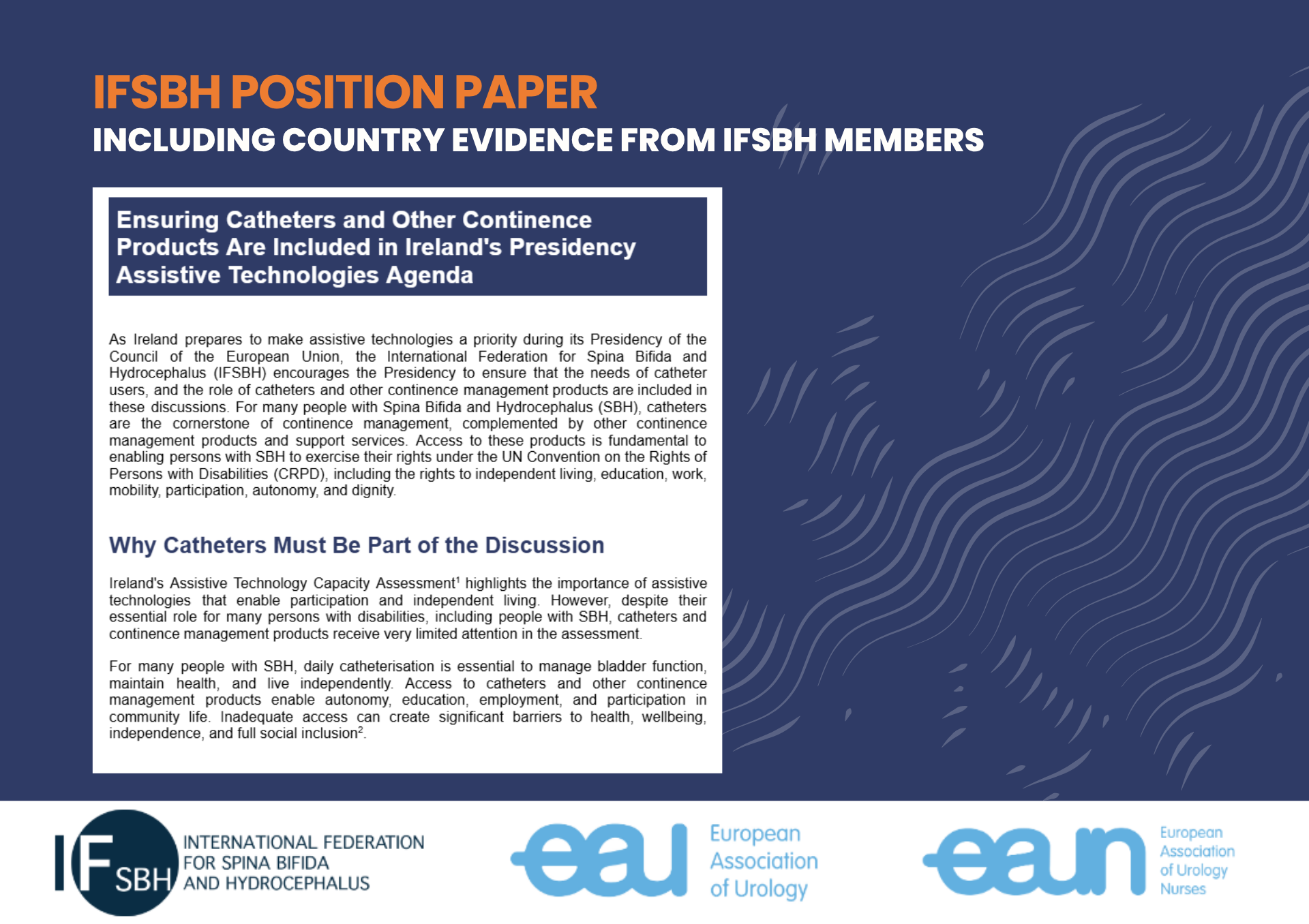
As Ireland places Assistive Technology among its priorities during its Presidency of the Council of the European Union, the International Federation for Spina Bifida and Hydrocephalus (IFSBH) is calling for catheters and other continence management products to be recognised and included in European discussions on Assistive Technology.
For many people with Spina Bifida and Hydrocephalus (SBH), catheterisation and continence management are essential parts of daily life. Access to the right products enables people to maintain their health, independence and dignity, and to participate fully in education, employment and community life.
Yet continence management needs remain insufficiently recognised within Assistive Technology policy discussions.
Bringing continence management into the European Assistive Technology discussion
In its new Position Paper, Ensuring Catheters and Other Continence Products Are Included in Ireland’s Presidency Assistive Technologies Agenda, IFSBH calls on the Irish Presidency to ensure that catheters and other continence management products are considered within European discussions on Assistive Technology.
The Position Paper highlights that access to these products is not simply a matter of healthcare provision. For people who rely on them every day, appropriate and affordable continence management products are essential to exercising fundamental rights, including independent living, education, employment, mobility, health and participation in society.
IFSBH is also calling for a user-centred approach that recognises the outcomes assistive products enable, rather than focusing solely on their regulatory classification. The Position Paper further emphasises the importance of meaningfully involving people who rely on catheterisation and their representative organisations in relevant policy discussions.
The Position Paper has received the support of the European Association of Urology (EAU) and the European Association of Urology Nurses (EAUN), strengthening the call for continence management needs to be reflected in European Assistive Technology policy.
From policy to lived experience
The call is further supported by practical evidence collected from IFSBH Member Associations across Europe.
The Country Evidence from IFSBH Members brings together experiences from eight countries, illustrating the different barriers people face in accessing appropriate catheters and other continence management products. These include reimbursement gaps, out-of-pocket costs, limited product choice, supply shortages, geographical inequalities and barriers to accessing appropriate products and support.
The country evidence also highlights examples of positive systems and successful advocacy, demonstrating that equitable access is possible when continence management products are recognised as essential to health and independence.
→ Explore the Country Evidence from IFSBH Members
Continuing the advocacy
Together, the Position Paper and country evidence provide a strong evidence base for IFSBH’s continued advocacy for equitable access to appropriate continence management products across Europe.
Recognising catheters and other continence management products as essential Assistive Technology is an important step towards ensuring that people with SBH can access the products they need to live independently, maintain their health and participate fully and equally in society.
IFSBH and its Irish member organisation, together with the European Association of Urology (EAU) and the European Association of Urology Nurses (EAUN), stand ready to contribute expertise, evidence and lived experience to discussions during the Irish Presidency and to work with relevant stakeholders towards more inclusive European Assistive Technology policies.