12 May 2026
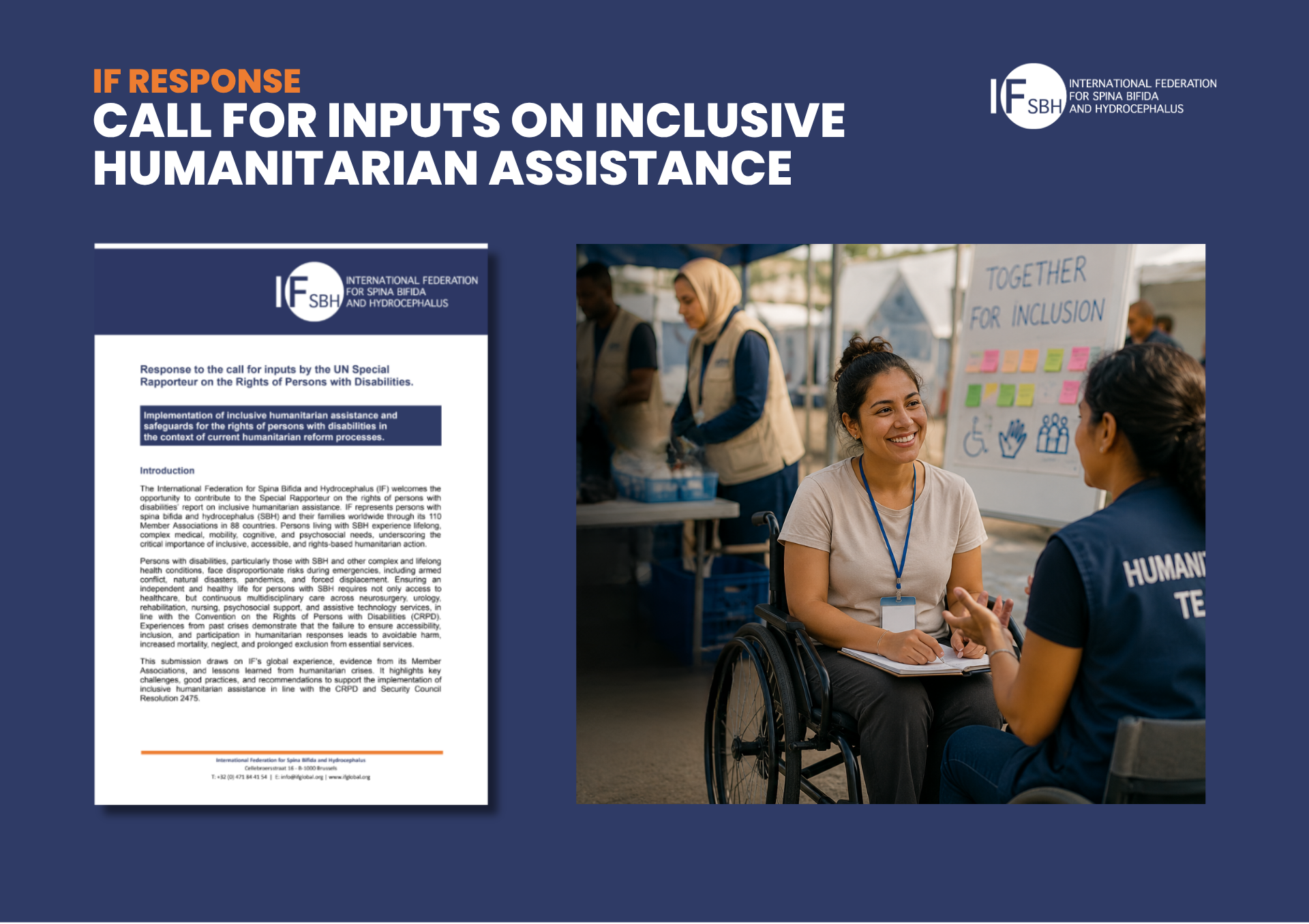
The International Federation for Spina Bifida and Hydrocephalus (IF), together with its Member Associations worldwide, has submitted a response to the United Nations Special Rapporteur on the rights of persons with disabilities as part of a consultation on inclusive humanitarian assistance.
The contribution highlights the urgent need to ensure that persons with disabilities, particularly those living with spina bifida and hydrocephalus (SBH), are fully included and protected in humanitarian settings.
A collective voice from across the IF network
This submission reflects the shared experience of IF Member Associations supporting individuals and families living with SBH across different regions. It is grounded in their daily work and the realities they report from crisis-affected contexts.
Members consistently highlight that emergencies, including conflict, natural disasters, pandemics and displacement, often disrupt essential services. For persons with SBH, this disruption can severely impact continuity of care, which depends on access to multidisciplinary support such as neurosurgical follow-up, urological care, rehabilitation, assistive devices and psychosocial services.
When these systems break down, individuals face increased health risks, reduced access to care and long-term consequences for wellbeing and inclusion.
Barriers in humanitarian response
Member organisations report that humanitarian responses still too often fail to include persons with disabilities in a systematic way.
Key barriers include inaccessible shelters and sanitation facilities, shortages of essential medical supplies such as catheters, disrupted healthcare systems, and limited disability-inclusive planning. These gaps place persons with SBH at particular risk in already fragile environments.
Strengthening inclusion and rights-based action
The IF submission reaffirms the importance of implementing the UN Convention on the Rights of Persons with Disabilities (CRPD), particularly obligations relating to protection in situations of risk.
It calls for stronger recognition of Organisations of Persons with Disabilities (OPDs) in humanitarian decision-making, improved disability-disaggregated data, increased funding for inclusion, and strengthened capacity among humanitarian actors.
A central message from Member Associations is the need to move beyond policy recognition and ensure meaningful inclusion in planning, implementation and response.
Intersectional risks and prevention
The submission also highlights intersectional risks, noting that women, girls and children with disabilities often face compounded barriers in humanitarian contexts, including increased exposure to exclusion and violence.
It further underlines the importance of preventive measures, such as access to maternal healthcare and folic acid supplementation, even in crisis settings, to reduce preventable neural tube defects.
Key recommendations from IF
Based on input from Member Associations, IF calls for:
- Embedding disability inclusion across all humanitarian action and reform processes
- Ensuring continuity of specialised SBH care and essential supplies in emergencies
- Strengthening meaningful participation of OPDs in decision-making
- Improving disability-disaggregated data collection and use
- Investing in capacity-building for inclusive systems
A shared commitment
This contribution reflects IF’s collective commitment, together with its Member Associations, to a rights-based and inclusive approach to humanitarian action.
It reinforces a clear message from across the network: persons with SBH must be fully included, supported and protected in all humanitarian responses, and never left behind in times of crisis.
Read the full IF submission on inclusive humanitarian assistance.